Thoughts

Photo-sharing apps more of deceptive lens to the outside world

20.2.17

Throughout our lives, we keep getting reminded that too much of anything isn’t good. Yet, oftentimes, humans have this bizarre tendency to overindulge in something that’s meant to be consumed in modest amounts. This is something I can vouch for, as I spend most of my time losing sleep over watching TV shows on Netflix, or eating too many fries in one sitting when I go to McDonald’s. 

Lately, young people appear to outstay their welcome in the social media realm. Lets face it: Almost everyone in this era can be categorized as a ‘nomophobic’ or “a person who has a fear of being out of mobile phone contact.” For example, when my phone’s battery is dying and I don’t have a charger with me, I feel like I am carrying a ticking time bomb that will explode once my phone switches off; and once it does, I feel disconnected from the rest of the world until I revive my device. 

But what do we so-called millenials do on our smartphones besides getting sucked into a vortex of infinite posts on our Instagram feed and tapping through Snapchat stories of friends that we’ve met once, two years ago? For 71 percent of us—according to the Pew Research Institute—not much. 

It’s something that we are all used to—checking and re-checking each of our social media accounts right before heading to bed, the following morning upon waking up and whenever we get the chance in between. Falling prey to this routine gradually made me realize that social media can be a deceptive lens to the outside world. 

Nowadays, it’s so important for people to have a vibrant social media presence that much of their effort goes into maintaining an ‘aesthetic feed’. Convenient crops and filters allow users to reduce their experiences to little square stills to orchestrate the life they want people to think they lead. It seems as though they are giving up some good time in real life to show that they are having a good time on Snapchat or Instagram.

In hindsight, we can barely make it through a simple meal without exclaiming, “Hold on, let me take a picture first!” and then waste another four minutes strategically formatting the dishes on the table, not giving the slightest care about the people around us who just want to eat the food. Other than that, the advent of photo-sharing apps makes it a rarity to enjoy a gathering with friends without someone saying, “Let’s take a selfie!” (which, by the way, is never just one selfie). These are modern day examples of people who unplug from real life in order to document it—because they are convinced that their entire day will go to waste if they don’t post any evidence of it.

The fixation with getting “likes” and posting content that will be well received creates constant competition, where the quantity of likes and followers people have determines their self-esteem. The more followers they can garner to like their #selfie, the better they feel about themselves.

There are a few people I know who beat themselves up over not getting as many red hearts on their picture. To avoid that experience, they post pictures on Instagram during ‘peak hours’ for the sake of getting more approval. Some even delete posts that have hardly received any likes just moments after uploading them, out of fear that they will come off as unworthy. It is due to this mindset that people set unrealistic social media targets for themselves.

Such obsessive habits spell out a toxic culture of continuous self-assessment, resulting in serious declines of morale. Pakistani-American internet personality reporte and blogger Samia Khan in her TEDx Talk suggests, “This type of virtual comparison leads to feelings of inadequacy, leaving you feeling more pressured.” She highlights that the motivation behind this hyper-positivity and self-inflating behavior on Snapchat and Instagram revolves around the need to be ‘validated’ and ‘celebrated.’ 

“These affirmations are hugely powerful, because they influence and trigger the pleasure center in our brain—we’ll do anything for that little dose of dopamine,” she explains. Once we attain gratification by uploading positive posts, we yearn for it more and realize that sharing selfies and accomplishments is the best way to get it. But what we fail to understand is, that “what we see is just the tip of the metaphorical iceberg. There are greater, more personal realities looming underneath the surface”, adds Khan.

Technology is a boon and smartphones are exciting tools that have taught and will continue to teach us a great deal. We literally have the whole internet (which basically equates to all that’s important about the world) at the tips of our fingers. But this makes it easier for our phones to turn from useful gizmos into black holes, diverting our attention away from reality and directing it toward a torrent of information about the lives of people we don’t really know.

The photo-sharing apps on your smartphone are not meant to be used as social crutches. Use your phone when you need to do something specific, and put it away when you’re done. Don’t get so caught up in portraying a good life that you forget to actually lead one.

Thoughts

Let's talk about the pressure of getting married in your 20s

16.2.17

I recently had a small get-together with my high-school friends. The conversation between us revolved around reminiscing about our time as students way back then, jobs, keeping up to date with what was happening with our respective lives and gossiping.

And then this topic came up: Marriage.

A female friend said this during our meeting: “My parents are very traditional; they want me to get married before I turn 30."

Another friend chimed in, “You know this so-and-so is also feeling galau [insecure] lately because she’s still single.”

This type of conversation about relationship and marriage has become a staple discussion whenever I go out with my fellow female friends who are in their 20s. The constant chatter about it prompts me to wonder - why are we under so much pressure to get hitched before we hit 30?

Out of frustration, I once asked my mother about this and this is what she said to me, “There’s this stigma surrounding women who are still not married by the age of 30 being labeled as ‘unwanted’ or ‘left over’.”

It saddened me to hear her answer because it underlies the message that for us women, despite how hard we’ve worked to make a living, or no matter how well educated you are, you’re still a failure if you don’t get yourself a husband.


A survey conducted in 2012 by Yahoo! She Indonesia found that of 7,335 female respondents asked “should women get married?” 37 percent answered no, while 63 percent preferred to settle down because “It is women’s fate”.

During a powerful TED Talk on feminism, famed novelist and writer Chimamanda Ngozi Adichie addresses this same issue, saying “We teach girls to shrink themselves, to make themselves smaller. We say to girls, you can have ambition, but not too much. You should aim to be successful, but not too successful. Otherwise, you would threaten the man. Because I am female, I am expected to aspire to marriage. I am expected to make my life choices always keeping in mind that marriage is the most important.”

At the end of the video, she acknowledges the need to change a culture that doesn’t fully acknowledge the humanity of women, explaining that it is not culture that makes people but people that make culture.

If culture is indeed the thing that has shaped our mindset, then let’s change it. Culture evolves as society evolves. In the past it might have been an acceptable norm for women to just wait for a man to ask for her hand in marriage because back then women weren’t even allowed to go to school and had to be kept at home until a man agreed to wed her.

But thanks to our national heroine R.A. Kartini, who fought hard for education for girls, now we are allowed to go to school just like boys. In fact, Indonesia’s school participation rate is higher for females than males nowadays and there are more female than male students in university.


So why do we still have to stick to the old tradition that doesn’t represent the current situation of women?

In a touching advertisement by cosmetic brand SK-II that went viral a few months ago, I was so moved by the single young Chinese women profiled in the video who bravely stood up against their parents’ pressure and the status quo that label them as “leftover women”. One woman said in the video, “I have a great career, and there’s another term for that: ‘powerful woman’.”

Your success in life doesn't depend on whether men find you attractive or not, success depends on yourself alone.

Be independent, be a leader, get your dream job, pursue your passion, be who you want to be and love who you want to love.

If you’re still single in your 20s,it’s not the end of the world! Being single can help you in finding your true self; it’s also the time where you can learn to love yourself. No one can make you happy until you're happy with yourself first.

And no, I’m not implying that all young women in their 20s should put marriage on hold before they turn 30. If you do want to settle down, make sure it is because you love that person and you feel that it really is the right time for you to share the rest of your future with this special someone.

Let the decision come from your heart and mind, not from the pressure that the society places upon your shoulders :)

Thoughts

Making plans is good, but life is what you make it

10.2.17

One day I had a conversation about life with two young friends of mine. They were in their mid 20s and full of energy.

I loved hearing about how they were dealing with the same things I dealt with. We each talked about how we had planned our life, including our career, love life, financial plans, ambitions etc.

Making plans is good because it means there is focus in our life. However, no matter how eager we are in planning our life, there are, unfortunately, things that we just cannot control.

Young people tend to make plans to study, score an ideal job or even get married by a certain age. Little do they know, the last one is something that is hard to plan for.

When I was young, I didn't set a target to get married by a certain age as I found the idea quite suffocating. What if I didn't meet a guy at that age? Would I get married just because I had planned it?

Planning to get married by a certain age when I didn't even have a boyfriend seemed too scary to me. I thought it would cause unnecessary stress in my life. Or, on the contrary, what if I met a guy way earlier before my set marriage date?

And not only that, when you are set on getting married or settling down with someone at a certain age, supposedly you pass that age and people start asking questions. Family gatherings on holidays from then on seem very hard to attend as you would have to answer that question again.

Nowadays, one is not only defined by marital status; unlike a century ago. Thus, making plans for your future, which include other people’s feelings, can be quite tricky.

When your plans fail to materialize, what happens? Perhaps you become stressed out, or worse, frustrated.


And all the fuss, for what? Enjoy your life instead. Go out see the world, work hard and prove yourself.


Then I remember my own quote:

"Planning your life into details and sticking to your plan doesn’t always work. Things in life do not go smoothly, and exactly as you plan. There are chances to take, risks to avoid, challenges to pursue and disappointments to deal with. Life is what you make it. Carpe Diem."

Love

My Own Kind of Mr. Right

30.1.17


In a relationship, surely we always search for the one, a partner that will accompany us throughout this bumpy and messy journey called life. I am indeed a very helpless romantic girl, a girl who believes in happily ever after, and has faith in the bells will ring when the one is finally arrive.

For almost 23 years of life, I have spent lots of relationship and it came along with a lot of heartbreaks too. 

More often than not, even when i feel “head over heels” for someone, the question tickles — “Is he The One?”

Through those relationships (and heartbreaks) I learned to distinguish what’s truly matter and what’s not, I learned to see my own value, and I finally know what I really pursue in a person.
It’s really not easy finding someone who’s just made for you, logic plus experience tells us that there is no such thing as Mr. Perfect, but I believe that Mr. Right does exist..

For me, Mr. Right is someone who doesn't make sense for anyone else, who just doesn't work with others, but with you - everything fit perfectly. 


2016 was a devastating year for me, the worst heartbreak that I could possibly have.

On that moment I seriously thought that I would never be able to open my heart anymore. 

How could I open it if it’s only just some broken pieces?
But again, I was wrong. It’s always able to be opened, only by the right one. 
And the right one not just opened, he even fixed it.

This guy.. He came all in sudden.
I didn’t hear the ring of the bell or feel the butterflies flew on my stomach on the first day I met him, 
but somehow, there was a huge eagerness to know him better. 

And the more days I spent with him, the better I know him, the more qualities I found.
See, I believe everyone has different criteria and priorities of what they search for in a man, 
but now as I grown up, I see lots of thing in different perspectives.
and he’s kinda has what I need..

Top of everything, kindness holds the top spot on my list — a characteristic I simply cannot live without.

And from the day one, it was his kindness that I straightly notice. 

He treats waiters, friends, strangers and everyone around him gently and kindly. 
Can you imagine how he treat me? 

Days passed, turned out that he’s such a family man. 
He’s the fourth child, or the youngest we can say.
He treats her mother like a queen and his brother is his role model for life. He is so close with all his niece or nephew, and he puts so much respect on his in laws.
He takes a really good care of his family, and he never forget to keep contact with them. 
Can you imagine when he run his own family? 😊

Since he is such a family man, I guess it’s not hard for him to get along with mine.

He’s willing to take huge leaps to make sure my family like him and see how much he cares for me.

He likes my family and i like his family, and  i hope it goes along with his family likes me and my family likes him.
I believe life is so much easier when we have each other’s family’s approval and blessings.
Everyone just gets along better, for the most part..


The closer we get, the more mesmerized I could be and I am surprised at just how much this guy notices about me, he knows all my particulars. 
He knows what-is-to and what-is-not to order for me at a restaurant, his gifts are thoughtful and magical, he cherishes everything about me and remember every little thing I say. 
It’s like, he listens twenty-four seven or something, 
and it’s always nice to have someone that actually listen.

For me, one of the biggest key to have a long and healthy relationship is having a great communication.
You and your partner should have the comfort to talk and share about everything that is going on in your life,

from the daily boring routines to your biggest dreams.

You need to be able to share and listen, and it should be balanced between the two of you. 
With him, I never run out of words. 
He pays a strong level of interest to my goals and dreams, he even always want to know how my day was. 
He whole-heartedly listen when I discuss something about my life and never make me feel like I’m boring him. 
I am, too, comfortable telling him everything because he makes me believe that he has my best interest at heart, and will always support me throughout my endeavors.

Finding the one means searching for a partner to annoy for the rest of your life, 
but remember, he will annoy you too! 
See, nobody’s perfect, we were all made from a complex series of flaws. 
And this is one of the most important thing we should take a look from someone’s character, his flaws. 
See the way he gets angry, the way he gets jealous, the way he handle problems between you two. See him in his worst day. We can’t expect him to change, trust me, his bad habit will only get worse years by years.. 
you can’t change him, but you can choose carefully what kind of problems you want to face every single day. 
In my case, I have seen him on his worst, but he still treated me the best.

For a very short period, there are many things I adore from him. 
His work ethics, his vision about the future, his huge achievements in such young age, his big love for the family and many more things that I can’t mention one by one here. 
And I always knew that I need a person to admire.
I don’t know how it works but he makes me want to be a better person. 
He makes me want to get up early or learn to cook, he makes me check off everything on my bucket list, and conquer all of my bad habits. He’s overhauled things I thought I knew and wanted, and opened my eyes to a whole new (and better) world that I never knew existed. 
He doesn’t validate my existence, he brightens it. He lets me be me, and he loves every bit of that individuality.
He encourages me in my endeavors and celebrate my success, and I genuinely happy to do the same to him. We’re not competing each other on proving who can do better or proving who’s right or wrong. 
We make such a great team, and we seem to shine in each other’s company.

It must be fun to have life partner that has lots of thing in common,

from favorite hobbies to the same food that we hate. 

But trust me, it’s so hard to find that kind of person, in fact, we often meet a totally different character. 
And it’s totally okay darling.. 
I love meat and he craves for chicken, I love K-Pop and he turned out to be the one who hates it. We may well have some interests or hobbles that differ, but when it comes to the big things, we agree 100%. While we may not agree on every little thing, we’re on the same page where it matters. 
We have the same idea of how a relationship should be, what kind of marriage we would like to jump in, how to raise kids, and other long-term life decisions.
Our overall goals, ambitions, virtues and values match.

I do believe that the right one will never leave you wonder whether he loves you or not, 
the right one will never leave you hanging with “where this is going on” – kinda question,

because men basically like hunters, they always go hard for what they want. 

And for me, this is the best criteria He has, He always make me feel wanted. 
Through all his small gestures give such a big impact for me. He never leave my texts unanswered, he posts my picture in his social media, he always make time for me even in his busiest days, he takes me to his inner circle, and he calls just to say he miss me. 
He doesn’t make promises, he takes real actions. 
He owns up to our relationship, he shows the world that he is proud to have me. 
He makes me feel loved, secure, and treasured.


And yeah, from all those criteria above, i think my journey has come to its end when I met him, Arif Sabta Aji, my own kind of mr. right..


Thoughts

Feeding Nation While Protecting Environment

27.1.17


The year 2016 has just ended, but a question remains. Will countries, including Indonesia, be able to supply food for their growing populations, taking into account the constraints of our limited natural resources?

The global demand for food, fiber and fuel is on the rise. This demand needs to be matched while we also need to ensure that our resources, landscape and ecosystems will be sustainably managed for the long term. Several projections, including from the Directorate General of Food Crops in 2013, for example, reveal that Indonesia’s rice consumption would exceed its production starting in 2020, taking into account land availability and climate change.

Threats to food security will likely increase as the population continues to soar and economic activities develop, while land availability becomes more limited. Hence, improved productivity and technological developments are necessary.

Globally traded commodities produced in Indonesia, namely palm oil, coffee and cocoa, face similar challenges.

Palm oil is one of the most efficient crops but the productivity level in Indonesia, especially on small farmers’ lands, is still relatively low at 3.2 tons of crude palm oil (CPO) per hectare — the global average is between 4 and 5 tons.

If productivity and practices are not improved, the increased global demand for palm oil could lead to expansion and exploitation of the remaining forests and peat lands and potentially to forest and land fires.

However, a decree for conservation has been adopted by the government, which is in tandem with global markets that increasingly support sustainable products.

Land cultivated for palm oil needs replanting. In South Sumatra alone, between 2016 and 2021, replanting needs are estimated to be at least 270,000 hectares.

The investment required for oil palm replanting could reach US$5,000 per ha. A new financial plan is needed to support replanting, especially if it involves small farmers.

Without adequate finances and technical support for replanting, growers and farmers could opt to expand their palm oil cultivation to high risk areas, such as forests and peat lands.

Concerning cocoa and coffee, low productivity is a huge challenge as land is often managed and cultivated by small farmers.

Low productivity has trapped small farmers in a cycle of poverty and a cycle of debt. The inability of small farmers to access finances and sound agriculture practices has led to reduced quality of input which in turn produces a low level of output (quantity and quality).

Without a provision of better input, farmers will have difficulty meeting global standards — hence, their struggle to break into the global market.

Funding for farmers is even more challenging because financial institutions perceive giving loans to small farmers as a high risk.

This perception relates to the unclear land status of farmers, low capability and accountability of farmer organizations and existing debt by farmers.

Innovation could help farmers gain agriculture knowledge, input material, improve farmer organizations and reduce investment risks. This is key to producing more with less — more productivity with less environmental impact.

Models for this have been tested across the globe, including in Indonesia.

A good model usually consists of a supply chain company committed as a long-term off-taker of commodities supplied by farmers, a farmer organization or cooperative, a bank that provides a soft-loan for a cooperative with a grace period taking into account the harvesting cycle, a provider of seeds and input materials and a donor or private foundation that provides technical support for farmers.

Such models have been applied in Aceh for aquaculture, Riau, Jambi and South Sumatra for palm oil, Lampung for coffee and Sulawesi for cocoa.

Individual corporations, organizations and banks or multi-stakeholders’ platforms, such as Partnership for Indonesia Sustainable Agriculture (PISAgro), are examining these models in collaboration with a number of cooperatives and government agencies.

A model in just one supply chain may not be enough as there are many challenges and issues shared among different actors in different supply chains.

These shared issues include land legality, water and landscape management, fire prevention and energy provision and require a holistic approach beyond just one farm or supply chain.

In Musi Banyuasin district, South Sumatra, a supply shed approach led by its regent is being tested to support the development of integrated sustainable commodities, such as palm oil, rice, rubber and protecting forests and peat lands.

This approach has gathered the support of local government agencies, mills and local and international organizations to collaboratively help identify and map independent small farmers and their challenges.

A combination of segregated supply chain and integrated supply shed approaches with clear financial support and sound agriculture practices is one of the most effective ways to develop commodities while protecting our fragile ecosystem.

The bold part of this journey is to build on these approaches to increase investment, develop commodity production and protect larger areas.

It is time for Indonesia to demonstrate its ability to “produce more with less”.

Thoughts

Food Consumption: What's Wrong With Eating Meat?

25.1.17


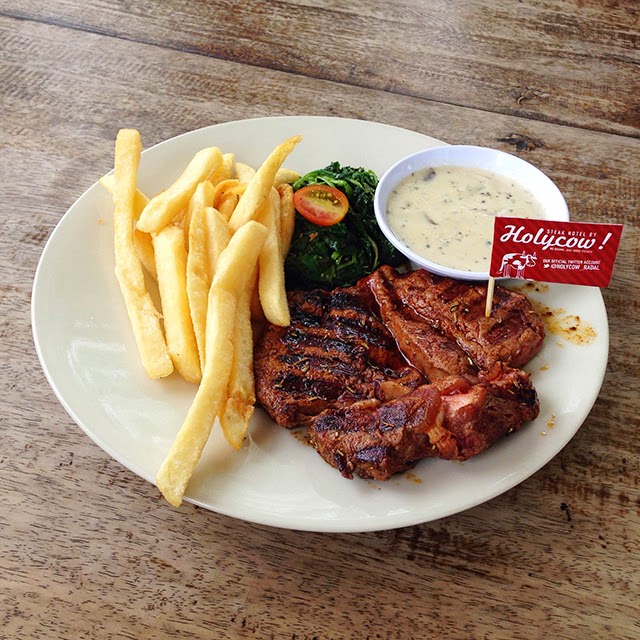
Every time I check my social media timeline, photos of food and beverages are the most common posts. Friends take photos of their food before eating their meals. I took a closer look at every single photo and found that meat was one of the most popular dishes.

More and more people are eating steak, beef burgers and meat-lover pizzas. Meat has become part of society, a sign of an urban lifestyle that indicates the rise of the middle-income sector. With all respect to vegans and vegetarians, meat is part of human history. 

We have eaten meat since the hunter-gatherer era. Now, 90 percent of the world’s population eats meat. Demand for meat will double in the next decades. Beef consumption in Indonesia was approximately 613,110 tons in 2015 and is estimated to grow to 642,760 tons by 2019.

The flip side of the coin is growing demand for meat, followed by growing awareness of the negative effects of meat production and consumption. Meat is not only touted as the biggest cause of global warming through greenhouse gas emissions but also linked to cancer and other dangerous diseases.

Meat does not have a good impression in the green community, with environmentalists or animal lovers. Meat may be not as bad as plastic bags or cigarettes, but meat has tended to become seen as one of many environmental problems. The meatless movement and stop-eating-meat campaigns have grown widely in some countries. 

The opinion piece by Reidinar Juliane and Satrio A. Wicaksono in The Jakarta Post (Sept. 25) entitled “Why sustainable diets are a big deal for humanity?” explained the concerns of a food gap. This gap, as stated in their piece, is partly induced by the fact that global food consumption patterns are shifting toward affluent, urban diets.

The writers said: “One action people can take to help address this food gap in a sustainable way is to reduce consumption of resource-intensive foods, such as animal-based foods, particularly beef, while increasing the intake of plant-based foods”.

I appreciate the attention of Juliane and Wicaksono on sustainable food. I agree with their thoughts about the importance of a sustainable diet. They state the benefits of sustainable food on the environment and our wellbeing.

In my point of view, efforts to reduce the food gap and achieve sustainable food must take place in all food chains. Reducing consumption of animal-based foods, particularly beef, is not a good way to fix the system. It is not easy to tell people what to eat or what not to eat, we will certainly face social and economic barriers.

I will not put myself into the debate of a meat advantage or disadvantage. But we can’t ignore and forget the nutritional benefits of meat. Telling people to reduce their meat consumption will eliminate the chance for people to benefit from meat’s nutritional value. In other words, there are many reasons to avoid meat but also lots of reasons to embrace meat.

We need a wider perspective to understand the food system as a whole, and what has gone wrong. The environmental impact and health problems from meat are caused by the way we produce meat, how we raise cattle, how we cook meat and how much meat we eat. Meat itself is a source of animal-based protein, essential amino acids and iron.

All foods that are over consumed are risky. Eating moderate amounts of well-prepared meat will have a low negative impact on our health. 

So, are plant-based foods safe, healthy? It depends on how we produce and treat the plants. Plant-based foods can become harmful when grown in an unsupervised manner and with the use of dangerous chemical pesticides or fertilizers. Some synthetic fertilizers also produce greenhouse gases.

To achieve sustainable food, we need to shake things up. We have to shift our way of farming. Good Agricultural Practices (GAP) must be put into effect. The environmental impact is most likely caused by the way we raise plants and animals. In the same way, health problems are sparked by the way we process food and the amount of the food that we eat.

Sustainable livestock farming to produce meat is more reliable then reducing meat consumption. There are some cattle grazing and feeding systems that can reduce greenhouse gases and enrich the soil. 

We can also practice animal welfare when handling farm animals. Yes, it’s not an easy task, but we can do it, one step at a time.

We have to admit that meat production has a bigger environmental footprint than that of fish or poultry. But is the less-meat-consumption campaign relevant for Indonesians? On a per capita basis, beef consumption in Indonesia is low, only 2.36 kilograms per capita in 2014. Some countries can be persuaded to eat less beef because they have a high level of meat consumption.

The most ideal food production method may be growing some of our own food, raising plants and animals in our backyards without using chemicals, because our commercial food travels hundred of kilometers from farm to plate and produces transport emissions. But it doesn’t have to be that way. 

We can achieve sustainable food by changing how we produce food and keep consuming it in appropriate amounts. So, we don’t have to lower our forks and step away from our steak knives.

Movie

La La Land, a rarely seen heartwarming love story

24.1.17


One word: Magnificent. An ode to a timeless classic with a touch of the 21st century.

La La Land has the spirit of a Gene Kelly production packaged in the body of a present-day blockbuster. It’s a transcendent experience, a must-watch-more-than-once for all film lovers.

Once glued to their seats, the audience is up for a ride into the lives of a passionate jazz pianist and a desperate wannabe actress. Their lives intersect in the most ridiculous yet most adorable of ways, and as they each pursue their own dreams and aspirations, both find themselves in an avenue of choice and regret. 

La La Land ignites with love, humor and in certain cases, sadness. The film is one that comes to life—the kind that gives you the illusion you’re watching real people living out their lives. 


Ryan Gosling and Emma Stone’s performances are both solid, yet it is the latter who deserves a standing ovation. Her ability to capture her character’s personality, ranging from the powerful drive of a Hollywood-dreamer to the fragile side of a girl from Boulder City, is present in the more memorable scenes.  

Damien Chazelle’s creation of a fantastical world in a reality-driven plot could not have been executed more skillfully. Immaculately choreographed dances coupled with wide shots and lateral camera work adds an extra dimension to the film that is a top contender at the upcoming 2017 Academy Awards. 

Chazelle’s roommate and Whiplash composer, Justin Hurwitz, has done it again, this time presenting us with a soundtrack that is light and dreamy with bits of melodrama and romance. Its musical numbers are satisfyingly upbeat, and tracks such as "Planetarium" and "City of Stars" erratically tickle that little portion of our hearts reserved for the most fragile of feels.

La La Land is seasoned with stuff rarely seen in a lot of today’s movies. It connects us with past arts and culture while maintaining a present-day storyline. It gives us a heartwarming love story, one that defies the archetypal plots, with a heartbreaking ending, and because of that it show us a grim truth: even glamorous Hollywood can’t escape the way life inevitably turns out.